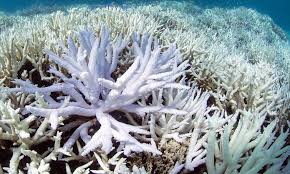
Coral bleaching occurs through the loss of the symbiotic algae found in living coral tissue. These zooxanthellae are responsible for giving healthy coral a brownish or greenish coloration. When these algae are lost, the white coloration of the underlying skeleton is visible through the translucent coral tissue. Partial bleaching may occur, resulting in only partial loss of zooxanthellae from the colony, as well as total bleaching when the entire coral colony appears bleach white.
This coral disease was first reported in the late 1800’s, however since 1980 extensive outbreaks affecting numerous species have been documented. The affects of bleaching vary greatly among species of corals as well as between individuals within the same species. Bleaching is believed to be a response to stressful environmental conditions. It is attributed to increases in ultraviolet radiation, extreme temperatures and salinities, and high levels of turbidity and sedimentation. Loss of zooxanthellae affects growth rates and overall health of the coral host.
Reference and Citation: Florida Museum (https://www.floridamuseum.ufl.edu/southflorida/habitats/corals/diseases/)
Most corals have a narrow temperature tolerance. Coral bleaching occurs when corals become stressed, most often when ocean water gets too warm. Corals will “eject” the symbiotic algae (called zooxanthellae) that live inside them. When corals lose their algae, they not only lose their color (turning white) but also their built-in food source. Scientists have declared three global coral bleaching events: 1998, 2010 and 2014-2017. This most recent event was the longest and most widespread bleaching event ever recorded, killing as much as two-thirds of the corals in the northern part of Australia’s Great Barrier Reef. Although corals can survive a bleaching event, they will eventually die if they are under repeated stress. Outbreaks of coral disease typically follow bleaching events since stressed corals are more susceptible to infection. A recent special report from the Intergovernmental Panel on Climate Change (IPCC) states that with an additional half-degree of warming above today’s levels, tropical coral reefs will face “very frequent mass mortalities,” although coral adaptation is possible. If temperatures rise an additional degree to 2 degrees above pre-industrial levels, coral reefs are in danger of vanishing entirely.
Reference and Citation: Coral Reef Alliance (https://coral.org/coral-reefs-101/reef-threats/global/)
Warmer water temperatures can result in coral bleaching. When water is too warm, corals will expel the algae (zooxanthellae) living in their tissues causing the coral to turn completely white. This is called coral bleaching. When a coral bleaches, it is not dead. Corals can survive a bleaching event, but they are under more stress and are subject to mortality.
In 2005, the U.S. lost half of its coral reefs in the Caribbean in one year due to a massive bleaching event. The warm waters centered around the northern Antilles near the Virgin Islands and Puerto Rico expanded southward. Comparison of satellite data from the previous 20 years confirmed that thermal stress from the 2005 event was greater than the previous 20 years combined.
Not all bleaching events are due to warm water.
In January 2010, cold water temperatures in the Florida Keys caused a coral bleaching event that resulted in some coral death. Water temperatures dropped 12.06 degrees Fahrenheit lower than the typical temperatures observed at this time of year. Researchers will evaluate if this cold-stress event will make corals more susceptible to disease in the same way that warmer waters impact corals.
Reference and Citation: National Ocean Service National Oceanic and Atmospheric Administration Department of Commerce
