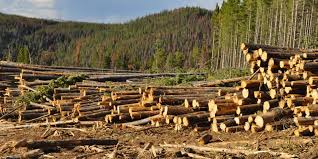
One of the main cause of deforestation is agriculture (poorly planned infrastructure is emerging as a big threat too) and the main cause of forest degradation is illegal logging. We’re losing 18.7 million acres of forests annually, equivalent to 27 soccer fields every minute.
Deforestation is a particular concern in tropical rain forests because these forests are home to much of the world’s biodiversity. In the Amazon around 17% of the forest has been lost in the last 50 years, mostly due to forest conversion for cattle ranching. Deforestation in this region is particularly rampant near more populated areas, roads and rivers, but even remote areas have been encroached upon when valuable mahogany, gold, and oil are discovered.
Farming, grazing of livestock, mining,
and drilling combined account for more than half of all deforestation. Forestry practices, wildfires and,
in small part, urbanization account for the rest. In Malaysia and Indonesia,
forests are cut down to make way for producing palm oil, which can be found in everything from shampoo to saltines. In the Amazon, cattle ranching and
farms particularly soy
plantations are key culprits.
Logging operations, which provide the world’s wood and paper products, also
fell countless trees each year. Loggers, some of them acting illegally, also build roads to access more and
more remote forests which
leads to further deforestation. Forests are also cut as a result of growing
urban sprawl as land is developed for homes.
Not all deforestation is intentional. Some is caused by a combination of human and natural factors like wildfires and overgrazing, which may prevent the growth of young trees.
Deforestation is considered to be one of the contributing factors to global climate change. According to Michael Daley, an associate professor of environmental science at Lasell College in Newton, Massachusetts, the No. 1 problem caused by deforestation is the impact on the global carbon cycle. Gas molecules that absorb thermal infrared radiation are called greenhouse gases. If greenhouse gases are in large enough quantity, they can force climate change, according to Daley. While oxygen (O2) is the second most abundant gas in our atmosphere, it does not absorb thermal infrared radiation, as greenhouse gases do. Carbon dioxide (CO2) is the most prevalent greenhouse gas. CO2 accounts for about 82.2 percent of all U.S. greenhouse gas, according to the Environmental Protection Agency (EPA). Trees can help, though. About 300 billion tons of carbon, 40 times the annual greenhouse gas emissions from fossil fuels, is stored in trees, according to Greenpeace.
The deforestation of trees not only lessens the amount of carbon stored, it also releases carbon dioxide into the air. This is because when trees die, they release the stored carbon. According to the 2010 Global Forest Resources Assessment, deforestation releases nearly a billion tons of carbon into the atmosphere per year, though the numbers are not as high as the ones recorded in the previous decade. Deforestation is the second largest anthropogenic (human-caused) source of carbon dioxide to the atmosphere (after fossil fuel combustion), ranging between 6 percent and 17 percent, according to a study published in 2009 in Nature.
Carbon isn’t the only greenhouse gas that is affected by deforestation. Water vapor is also considered a greenhouse gas. “The impact of deforestation on the exchange of water vapor and carbon dioxide between the atmosphere and the terrestrial land surface is the biggest concern with regard to the climate system,” said Daley. Changes in their atmospheric concentration will have a direct effect on climate.
Deforestation has decreased global vapor flows from land by 4 percent, according to an article published by the journal National Academy of Sciences. Even this slight change in vapor flows can disrupt natural weather patterns and change current climate models.
Reference and Citation ( External Link Included)
1. World Wildlife Organization (www.worldwildlife.org/threats/deforestation-and-forest-degradation)
2. National Geographic (www.nationalgeographic.com/environment/global-warming/deforestation/)
3. Live Science (www.livescience.com/27692-deforestation.html)
