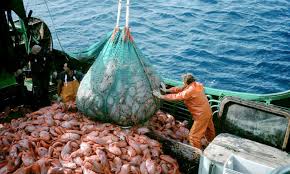
Marine scientists know when widespread overfishing of the seas began. And they have a pretty good idea when, if left unaddressed, it will end.
In the mid-20th century, international efforts to increase the availability and affordability of protein-rich foods led to concerted government efforts to increase fishing capacity. Favorable policies, loans, and subsidies spawned a rapid rise of big industrial fishing operations, which quickly supplanted local boatmen as the world’s source of seafood.
These large, profit-seeking commercial fleets were extremely aggressive, scouring the world’s oceans and developing ever more sophisticated methods and technologies for finding, extracting, and processing their target species. Consumers soon grew accustomed to having access to a wide selection of fish species at affordable prices.
But by 1989, when about 90 million tons (metric tons) of catch were taken from the ocean, the industry had hit its high-water mark, and yields have declined or stagnated ever since. Fisheries for the most sought-after species, like orange roughy, Chilean sea bass, and bluefin tuna have collapsed. In 2003, a scientific report estimated that industrial fishing had reduced the number of large ocean fish to just 10 percent of their pre-industrial population.
Reference and Citation: National Geographic
(https://www.nationalgeographic.com/environment/oceans/critical-issues-overfishing/)
overfishing occurs when we take too many fish from an area, and the remaining fish are unable to reproduce and replenish their populations to a healthy level.
The devastating collapse of the once iconic Northern Atlantic cod fishery in the early 1990s remains one of the most globally recognized cases of overfishing. Today, cod populations remain at low levels, with only a few populations showing signs of slow recovery.
Typically, fish species that are large and have long life spans are more vulnerable to overfishing than smaller fish with shorter life spans. Age of reproduction also plays a role.
For example, catching a species that reaches sexual maturity at an older age before it reproduces (e.g. B.C. rockfish may be 15 to 20 years old before they reproduce) has a twofold negative effect on the population–removing the individual fish, and all the potential offspring it could have had. Species that produce large numbers of offspring are also potentially less vulnerable than those that have just a few per year (e.g. porbeagle sharks, a bycatch species in Canadian fisheries, typically have just four pupsper year).
Reference and Citation: Sea Choice Organization
(https://www.seachoice.org/info-centre/fisheries/overfishing/)
According to the United Nations, over 70 percent of the world’s fisheries are either ‘fully exploited’, ‘over exploited’ or significantly depleted’. Some species have already been fished to commercial extinction, and more are on the verge of extinction. Regulation of fishing vessels is universally inadequate. More often than not, the fishing industry is given access to fish stocks before the longer term impact of their fishing practices is understood.
Overfishing is causing profound changes in our oceans, perhaps changing them forever. Over 90 per cent of large predatory fish, such as cod and tuna, have already been caught. Fishermen have responded by changing to new target species, often renaming them to make them sound more appealing to consumers. Hence the Patagonian Toothfish was reinvented as Chilean Seabass, while the wonderfully named Slimehead metamorphosed into the Orange Roughy. But as the larger species get fished out, fishermen are increasingly forced to look further down the food chain.
Overfishing doesn’t only threaten the fish species we target for food. Other species – such as marine mammals and seabirds – are caught incidentally in fishing gear and killed. This is known in the trade by the innocuous sounding word ‘bycatch‘.
Reference and Citation: Green Peace
(https://www.greenpeace.org.uk/what-we-do/oceans/overfishing/)
