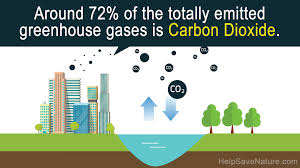
What is Green House Gas?
Any gas that has the property of absorbing infrared radiation (net heat energy) emitted from Earth’s surface and reradiating it back to Earth’s surface, thus contributing to the greenhouse effect. Carbon dioxide, methane, and water vapour are the most important greenhouse gases. (To a lesser extent, surface-level ozone, nitrous oxides, and fluorinated gases also trap infrared radiation.) Greenhouse gases have a profound effect on the energy budget of the Earth system despite making up only a fraction of all atmospheric gases. Concentrations of greenhouse gases have varied substantially during Earth’s history, and these variations have driven substantial climate changes at a wide range of timescales. In general, greenhouse gas concentrations have been particularly high during warm periods and low during cold periods.
Reference and Citation: Encyclopedia Brittanica (https://www.britannica.com/science/greenhouse-gas)
Writers acknowledgement : Michael E. Mann
Four Main Green House Gases
- Carbon dioxide (CO2): Carbon dioxide enters the atmosphere through burning fossil fuels (coal, natural gas, and oil), solid waste, trees and other biological materials, and also as a result of certain chemical reactions (e.g., manufacture of cement). Carbon dioxide is removed from the atmosphere (or “sequestered”) when it is absorbed by plants as part of the biological carbon cycle.
- Methane (CH4): Methane is emitted during the production and transport of coal, natural gas, and oil. Methane emissions also result from livestock and other agricultural practices and by the decay of organic waste in municipal solid waste landfills.
- Nitrous oxide (N2O): Nitrous oxide is emitted during agricultural and industrial activities, combustion of fossil fuels and solid waste, as well as during treatment of wastewater.
- Fluorinated gases: Hydrofluorocarbons, perfluorocarbons, sulfur hexafluoride, and nitrogen trifluoride are synthetic, powerful greenhouse gases that are emitted from a variety of industrial processes. Fluorinated gases are sometimes used as substitutes for stratospheric ozone-depleting substances (e.g., chlorofluorocarbons, hydrochlorofluorocarbons, and halons). These gases are typically emitted in smaller quantities, but because they are potent greenhouse gases, they are sometimes referred to as High Global Warming Potential gases (“High GWP gases”)
Reference and Citation: United states Environmental Protection Agency ( EPA ) (https://www.epa.gov/ghgemissions/overview-greenhouse-gases)
Green Houses Gases
11. Water Vapor (H2O) –
Water vapor, although it sounds innocent enough, is one of the biggest contributors to global climate change. Interestingly, water vapor is not directly emitted from human activity. It is in response to already rising temperatures. As the atmosphere becomes higher, the rate of water evaporation also increases. This water vapor tends to stay in the lower atmosphere where it absorbs infrared radiation and pushes it down to the earth’s surface, causing already hot temperatures to continue to rise.
10. Ozone (O3) –
Ozone presents itself in two forms, stratospheric and tropospheric. Stratospheric ozone occurs naturally. Tropospheric ozone, however, is a greenhouse gas that contributes to climate change. Humans produce this gas through industrial plants, chemical solvents, and burning fossil fuels. Prior to industrialization, tropospheric ozone was concentrated at 25 parts per billion in the atmosphere. Today, it is at approximately 34 parts. When O3 mixes with carbon monoxide, the combination results in smog. Taking public transportation, avoiding pesticides, and buying natural cleaning products are all ways to reduce ozone production.
9. Nitrogen Trifluoride (NF3) –
Nitrogen trifluoride is produced by industrial gas and chemical companies. It is recognized by the Kyoto Protocol as a greenhouse gas that contributes to global climate change. It has an atmospheric life of between 550 and 740 years. Under this environmental treaty, member countries have committed to reducing emissions of this gas.
8. Sulfur Hexafluoride (SF6) –
Sulfur hexafluoride is an electrical insulator, and generally is used in the form of a liquefied compressed gas. It is not very water soluble, but does dissolve in organic solvents. It has an atmospheric life of 3,200 years and global warming potential 23,900 times stronger than carbon dioxide. SF6 is considered one of the most dangerous greenhouse gases known. It is banned as a tracer gas and is limited to high voltage applications. In addition, the US Department of Energy repaired leaks in several laboratories, thereby reducing emissions by 35,000 pounds a year.
7. Hexafluoroethane (C2F6) –
Hexafluoroethane is a fluorocarbon that is used in the semiconductor industry, and is sourced from byproducts of aluminum production processes. It has a 10,000-year atmospheric lifespan and a global warming potential of 9,200. Prior to industrialization, this gas did not exist in the atmosphere. Humans may suffocate around this gas, if exposed to high concentrations.
6. Tetrafluoromethane (CF4) –
Tetrafluoromethane is a nonflammable gas that belongs to the fluorocarbon family. Utilization of the Hall-Heroult process in aluminum production results in this gas. Additionally, it is used as a refrigerant. CF4 is a strong greenhouse gas that contributes to climate change and has an atmospheric lifetime of 50,000 years. Because of its low concentration level in the atmosphere, it is not currently believed to have a significant radiative forcing effect, which leads to rising global temperatures. However, its presence is constantly increasing which will lead to global warming. It does not deplete the ozone.
5. Chlorodifluoromethane (CHClF2) –
Chlorodifluoromethane belongs to the hydrochlorofluorocarbon family of gases, and is most commonly used as a refrigerant and propellant. This greenhouse gas contributes significantly to ozone depletion and global warming. Despite the dangers associated with its use, CHCIF2 is sometimes used in place of other gases with higher ozone depleting potential. However, the European Union has banned manufacturing this gas as well as prohibited its use in servicing refrigeration and air conditioning equipment, and only recycled chlorodifluoromethane is permitted. Any broken equipment must be replaced by an alternative that does not contain this gas. The same reduction and phase-out strategy has been employed in the United States.
4. Dichlorodifluoromethane (CCl2F2) –
Most commonly referred to as Freon-12, Dichlorodifluoromethane is used in aerosol spray cans and as a refrigerant. It is believed to have an atmospheric life of approximately 102 years, when it is finally degraded by solar radiation. Unfortunately, its degradation actually allows it to destroy the ozone layer. A weak or broken ozone layer allows the sun’s ultraviolet rays to enter the earth’s atmosphere. It was a popular choice for auto air conditioning units prior to 1994. After the Montreal Protocol, manufacturing this greenhouse gas became illegal due to its disastrous effects on the ozone layer. It is, however, still permitted for use as a flame retardant in air vehicles and on submarines.
3. Nitrous oxide (N2O) –
Nitrous oxide is produced by industrial manufacturing, the combustion of fossil fuels, and the breakdown of agricultural fertilizer. Additionally, it occurs naturally in the ground. Nitrous oxide is a compressed liquefied gas that has an atmospheric life of 114 years and a global warming potential that is 298 times stronger than carbon dioxide. This means it traps heat in the earth’s atmosphere at a much higher rate than carbon dioxide. This gas has several uses, including as a rocket motor oxidizer, as an internal combustion engine speed booster, as an aerosol spray propellant, and as an anesthetic and pain reliever in dentistry, childbirth, and surgery around the world. The US government has agreed to analyze, measure, and publish greenhouse gas emission measurements per the United Nations Framework Convention on Climate Change. Of US emissions, approximately 75% come from the agricultural industry. Despite its danger to the environment, nitrous oxide is expected to remain one of the largest greenhouse gas emissions in the future.
2. Methane (CH4) –
Methane is 25 times stronger than carbon dioxide in terms of its global warming potential. It also has a lifespan of 12 years. This gas occurs both naturally and as a result of human activity. Naturally, it originates in wetlands, volcanoes, methane-producing insects and animals, and within the oceanic floor. Human activity such as burning fossil fuels, raising livestock, cultivating rice, and dumping in landfills are all contributing to increasing presence of this gas. When controlled, the earth has natural sinks that help absorb methane, however excess human production has proven to exceed what the earth can naturally absorb. Pre-industrial levels were approximately 700 parts per billion. Today, that has increased to 1,870 parts per billion.
1. Carbon Dioxide (CO2) –
Perhaps the most well-known global greenhouse gas is carbon dioxide. It occurs naturally in volcanoes, hot springs, groundwater, and glaciers. As these geologic formations release carbon dioxide, plants rely on it to perform photosynthesis which results in oxygen production. Today, human activity such as fossil fuel burning, cement production, deforestation, agriculture, and development all contribute to increased carbon dioxide production. It currently has 388,500 parts per billion in the atmosphere, which is an 108,500 increase since before industrialization. With such high concentrations in the atmosphere, plants are unable to keep up by removing it from the air. Because this gas absorbs and emits infrared radiation, it contributes significantly to global warming.
Reference and Citation: World Atlas
(https://www.worldatlas.com/articles/list-of-greenhouse-gases.html)
Greenhouse gases warm the planet
Scientists know with virtual certainty that increasing greenhouse gas concentrations tend to warm the planet.In computer-based models, rising concentrations of greenhouse gases produce an increase in the average surface temperature of the earth over time. Rising temperatures may produce changes in precipitation patterns, storm severity, and sea level. Collectively, this is commonly referred to as climate change.
Assessments by the Intergovernmental Panel on Climate Change (IPCC) suggest that the earth’s climate warmed 0.85 degrees Centigrade (1.53 degrees Fahrenheit) between 1880 and 2012 and that human activity affecting the atmosphere is likely an important driving factor. The IPCC’s Fifth Assessment Report (Summary for Policymakers) states, “Human influence has been detected in warming of the atmosphere and the ocean, in changes in the global water cycle, in reductions in snow and ice, in global mean sea level rise, and in changes in some climate extremes. It is extremely likely that human influence has been the dominant cause of the observed warming since the mid-20th century.”
The report later states, “It is extremely likely that more than half of the observed increase in global average surface temperature from 1951 to 2010 was caused by the anthropogenic increase in greenhouse gas concentrations and other anthropogenic forcings together.”
The report also states, “Concentrations of CO2, CH4, and N2O now substantially exceed the highest concentrations recorded in ice cores during the past 800,000 years. The mean rates of increase in atmospheric concentrations over the past century are, with very high confidence, unprecedented in the last 22,000 years.”
Reference and Citation:
Independent Statistics and Analysis, U.S Energy Information Administration ( EIA )
(https://www.eia.gov/energyexplained/index.php?page=environment_how_ghg_affect_climate)
What is happening because of greenhouse gases?
Despite evidence that greenhouse gases have a detrimental effect on the
environment, many people are unconcerned about the effects of climate change.
However, when learning that greenhouse gases may also affect the energy sector,
some skeptics will give the evidence a second thought.
For example, hotter summers lead to a major increase in electricity
uses, which may drive up the costs during peak times. Another factor is the
fact that some types of power plants use water in their cooling systems. In
settings with high temperatures and drought conditions, this may pose a very
real energy crisis.
When climate change due to greenhouse gases occurs, it affects power plants in
a significant way. Plans for new power plants have often been disrupted because
of concerns about whether rainfall amounts will allow for enough cooling. One
alternative commonly suggested is air-powered cooling. However, this is an
expensive option.
Reference and Citation:
RGS Energy
