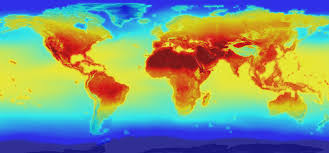
What is Global Warming?
The phenomenon of increasing average air temperatures near the surface of Earthover the past one to two centuries. Climate scientists have since the mid-20th century gathered detailed observations of various weather phenomena (such as temperatures, precipitation, and storms) and of related influences on climate (such as ocean currents and the atmosphere’s chemical composition). These data indicate that Earth’s climate has changed over almost every conceivable timescale since the beginning of geologic time and that the influence of human activities since at least the beginning of the Industrial Revolution has been deeply woven into the very fabric of climate change.
Reference and Citation: Encyclopedia Britannica
(https://www.britannica.com/science/global-warming)
What is the Causes of Global Warming?
Global warming is primarily a problem of too much carbon dioxide (CO2) in the atmosphere—which acts as a blanket, trapping heat and warming the planet. As we burn fossil fuels like coal, oil and natural gas for energy or cut down and burn forests to create pastures and plantations, carbon accumulates and overloads our atmosphere. Certain waste management and agricultural practices aggravate the problem by releasing other potent global warming gases, such as methane and nitrous oxide. See the pie chart for a breakdown of heat-trapping global warming emissions by economic sector.
The Consequences of a Warming World
Over the last century, global average temperature has increased by more than 1°F (0.7°C). The 2001-2010 decade is the warmest since 1880—the earliest year for which comprehensive global temperature records were available. In fact, nine of the warmest years on record have occurred in just the last 10 years. This warming has been accompanied by a decrease in very cold days and nights and an increase in extremely hot days and warm nights. The continental United States, for example, has seen record daily highs twice as often as record daily lows from 2000 to 2009. While the record shows that some parts of the world are warming faster than others, the long-term global upward trend is unambiguous.
Of course, land and ocean temperature is only one way to measure the effects of climate change. A warming world also has the potential to change rainfall and snow patterns, increase droughts and severe storms, reduce lake ice cover, melt glaciers, increase sea levels, and change plant and animal behavior.
Reference and Citation:
Union of Concerned Scientists
(https://www.climatehotmap.org/about/global-warming-causes.html)
What is the Major Effect of Global Warming to the Environment?
The effects of global warming on the Earth’s ecosystems are expected to be profound and widespread. Many species of plants and animals are already moving their range northward or to higher altitudes as a result of warming temperatures, according to a report from the National Academy of Sciences.
“They are not just moving north, they are moving from the equator toward the poles. They are quite simply following the range of comfortable temperatures, which is migrating to the poles as the global average temperature warms,” Werne said. Ultimately, he said, this becomes a problem when the rate of climate change velocity (how fast a region changes put into a spatial term) is faster than the rate that many organisms can migrate. Because of this, many animals may not be able to compete in the new climate regime and may go extinct.
Additionally, migratory birds and insects are now arriving in their summer feeding and nesting grounds several days or weeks earlier than they did in the 20th century, according to the EPA.
Warmer temperatures will also expand the range of many disease-causing pathogens that were once confined to tropical and subtropical areas, killing off plant and animal species that formerly were protected from disease.
These and other effects of global warming, if left unchecked, will likely contribute to the disappearance of up to one-half of Earth’s plants and one-third of animals from their current range by 2080, according to a 2013 report in the journal Nature Climate Change.
Reference and Citation:
Live Science
(https://www.livescience.com/37057-global-warming-effects.html)
What is the Major Effect of Global Warming to the Human Health?
A changing climate thus affects the prerequisites of population health: clean air and water, sufficient food, natural constraints on infectious disease agents, and the adequacy and security of shelter. A warmer and more variable climate leads to higher levels of some air pollutants. It increases the rates and ranges of transmission of infectious diseases through unclean water and contaminated food, and by affecting vector organisms (such as mosquitoes) and intermediate or reservoir host species that harbour the infectious agent (such as cattle,[14] bats and rodents). Changes in temperature, rainfall and seasonality compromise agricultural production in many regions, including some of the least developed countries, thus jeopardising child health and growth and the overall health and functional capacity of adults. As warming proceeds, the severity (and perhaps frequency) of weather-related disasters will increase – and appears to have done so in a number of regions of the world over the past several decades. Therefore, in summary, global warming, together with resultant changes in food and water supplies, can indirectly cause increases in a range of adverse health outcomes, including malnutrition, diarrhea, injuries, cardiovascular and respiratory diseases, and water-borne and insect-transmitted diseases.
Reference and Citation:
Wikipedia
(https://en.wikipedia.org/wiki/Effects_of_global_warming_on_humans)